
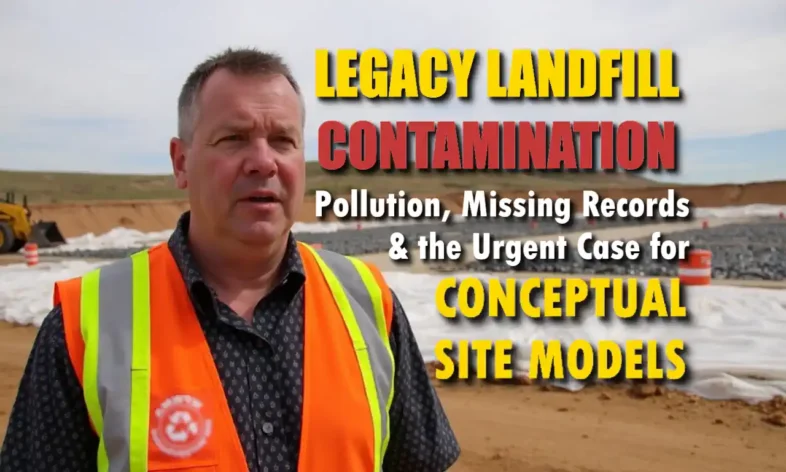
Legacy landfills, which are often unlined and date back to before modern environmental regulations, pose significant risks due to potential leakage of hazardous materials into soil and water, especially as climate-driven flooding and erosion intensify. These sites may contain heavy metals, asbestos, persistent organic chemicals (PFAS), and plastics, with thousands in the UK alone at high risk of releasing these contaminants into the environment.
It is not a crisis in the headline-grabbing sense of the word. There is no single catastrophic event, no sudden spike in reported incidents, no dramatic escalation that has forced the issue onto the front pages.
What there is, instead, is something in some respects harder to address: a persistent, slow-moving, and largely invisible problem that surfaces in ones and twos — a river reach with unexplained elevated ammonia, a private borehole returning results that don’t quite add up, a planning application that prompts a closer look at what lies beneath a former landfill or industrial site — and that consistently arrives on the desks of people who are already stretched well beyond their comfortable capacity to deal with it.
Across the UK, a steady trickle of old closed landfill sites and legacy contaminated land sites are being identified, or are coming back to attention, as suspected or confirmed sources of pollution. The problems they present vary considerably in their nature and severity.
Some involve active leachate migration reaching watercourses or groundwater abstractions. Some involve landfill gas generating concerns in relation to adjacent development.
Some involve contaminated land that has sat in a local authority’s Part IIA inspection register for years, acknowledged as a concern but never progressed to formal assessment for want of the resources to do so.
What these sites share is a common characteristic: they are difficult, technically demanding, and resource-intensive to deal with competently — and they are arriving at a rate that consistently exceeds the capacity of the organisations responsible for managing them to respond in the thorough, timely way that good environmental management requires.
This article examines why that is the case, what makes legacy landfill and contaminated land problems so difficult for hard-pressed local authorities and site operators to handle effectively, and why the Conceptual Site Model is not a bureaucratic luxury in this context but an essential practical tool for managing these challenges at all.
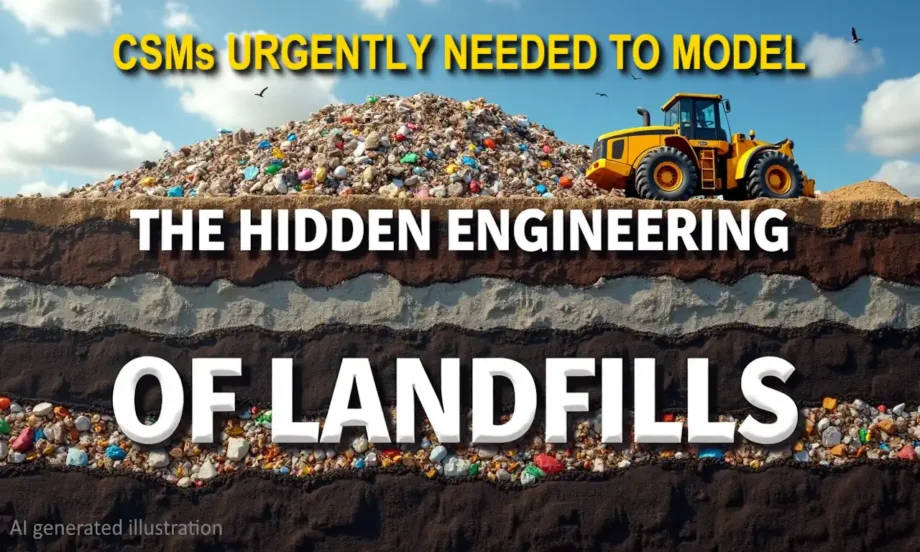
Key Takeaways
- The UK’s legacy closed landfill and contaminated land problem is not a sudden crisis but a persistent, ongoing challenge — a steady trickle of sites generating pollution concerns that consistently exceeds the capacity of responsible organisations to address competently and in a timely way.
- Water contamination from old unlined landfill sites — affecting groundwater, rivers, streams, and private water supplies — is among the most common and most consequential pollution problem associated with legacy sites, and is frequently slow-moving, diffuse, and difficult to attribute without systematic investigation.
- A critical practical barrier is the loss of historical records. Predecessor authorities, defunct operators, and decades of inadequate archiving have left current staff with seriously incomplete information about what many legacy sites contain, where the waste boundaries lie, and what pollution risks may be present.
- Local authority contaminated land teams and waste management site operators are managing these challenges against a backdrop of sustained financial pressure, reduced staffing, and diminished specialist expertise — making competent, timely responses to legacy landfill problems genuinely difficult to deliver.
- The Conceptual Site Model is the foundational document for any competent assessment of a legacy landfill or contaminated land site. Without one, site investigation is poorly directed, risk assessment is structurally flawed, and any regulatory action taken is vulnerable to challenge.
- Many legacy sites either have no CSM at all or have one that was produced years ago and bears little relationship to what is currently understood about the site. Both situations represent a significant professional and regulatory risk for the organisations responsible.
- Developing a workable CSM for a legacy site with missing or incomplete records is possible — but requires specialist methodology, forensic historical research skills, and a clear framework for working productively with uncertainty rather than being paralysed by it.
- The cost of not investing in adequate CSM development for legacy sites is, in almost every case, substantially higher than the cost of doing so — measured in wasted investigation spend, ineffective remediation, regulatory exposure, and continuing environmental harm.
A Steady Trickle, Not a Flood — But No Less Demanding for That
It is important to be accurate about the nature and scale of the legacy landfill problem in the UK, because overstating it is as unhelpful as understating it. The picture is not one of a sudden wave of new contamination incidents overwhelming local authorities and regulators.
It is something more nuanced: a consistent, ongoing stream of legacy sites that surface as concerns:
— through routine monitoring, through planning consultations, through resident complaints, through the gradual accumulation of environmental monitoring data that begins to tell an uncomfortable story
— and that demand a competent, resource-intensive response from organisations that are structurally ill-equipped to provide one at the rate and quality required.
The legacy of the UK’s pre-modern-standards waste disposal era is real and substantial. Thousands of old disposal sites across England, Wales, Scotland, and Northern Ireland were filled under regulatory regimes that bear almost no resemblance to the modern sanitary landfill standards that came into force from the 1990s onward.
- Before the Environmental Protection Act 1990,
- before the Landfill Regulations 2002,
- before the modern environmental permitting system — and in many cases
- before even the limited requirements of the Deposit of Poisonous Waste Act 1972
These sites received a wide range of waste with minimal or no engineered containment, no leachate management, no gas controls, and no requirement for systematic aftercare or monitoring. Many were closed with little more than a surface restoration and left to the long, slow processes of biodegradation and environmental attenuation.
Most of these sites are not, at any given moment, generating acute, dramatically visible pollution incidents.
The contamination processes at legacy landfills are typically slow and diffuse — characterised by:
- the steady, gradual migration of leachate through permeable geological strata,
- by the low-level but persistent generation of landfill gas in waste masses that have not yet fully stabilised,
- by the incremental deterioration of water quality in receiving groundwater bodies that have no formal monitoring network to detect it.
It is precisely this slow, undramatic quality that makes the problem so hard to manage: it does not force itself onto the agenda with the urgency of an acute incident, but it does not go away either.
Water Pollution: The Persistent Environmental Consequence
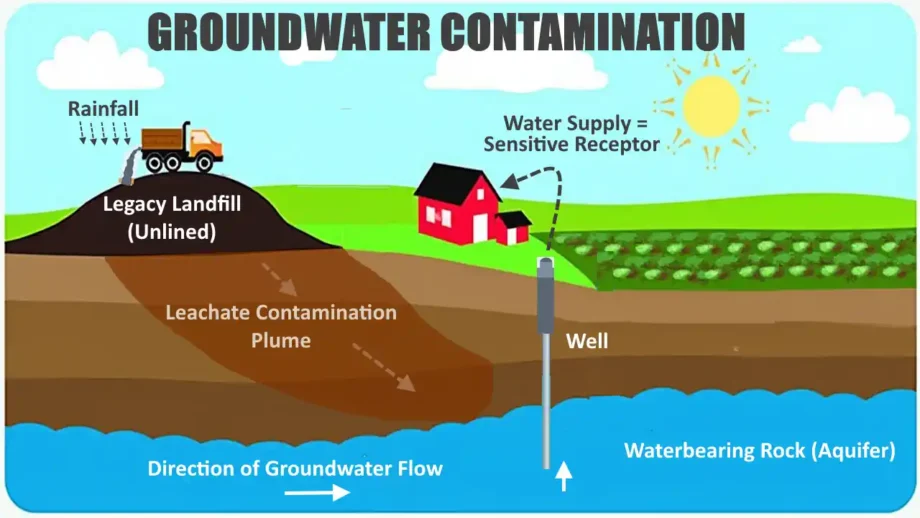
Of the various environmental impacts generated by legacy closed landfill sites, water pollution — of groundwater, surface water, and in some cases private water supply abstractions — is the most widespread and the most consequential. It is also, in the legacy landfill context, typically the most difficult to investigate, characterise, and attribute with confidence.
The mechanism is straightforward. Rainfall percolating through the uncontained waste mass of an old unlined landfill becomes leachate — a chemically complex liquid that dissolves and mobilises the soluble components of the waste through which it passes.
In the absence of a liner and leachate collection system, this leachate migrates downward into the underlying geology and then laterally through the groundwater system, following the natural hydraulic gradient of the local aquifer.
The distance it travels and the concentrations at which it arrives at any given receptor depend on the permeability and attenuation capacity of the intervening geology, the leachate generation rate, and the hydraulic gradient — all of which vary considerably from site to site.
In receiving watercourses, the characteristic signature of landfill leachate influences:
— elevated ammonia, elevated chloride, elevated biochemical oxygen demand, and
— a suite of trace organic compounds can be detected in water quality monitoring data, often at concentrations that have measurable ecological impacts.
Sensitive invertebrate communities, fish populations, and riparian vegetation can all be adversely affected by sustained leachate inputs to surface water, even at concentrations that fall below the thresholds that would trigger formal regulatory designation.
The difficulty, and it is a significant one in practice, is attribution. A watercourse that shows elevated ammonia or suppressed ecological condition in a reach downstream of an old landfill may be affected by that landfill’s leachate — or it may be affected by:
- agricultural runoff,
- by misconnected drainage,
- by historical industrial contamination from a different source entirely, or
- by some combination of all of these.
Establishing that a legacy landfill is the causative or contributory source of a water quality problem requires:
- a quality of hydrogeological investigation,
- groundwater monitoring, and
- contaminant pathway analysis that takes time, expertise, and money to deliver
— all three of which are typically in short supply in the organisations responsible for doing it.
Private water supplies present a particularly concerning subset of the problem. Rural properties and small communities served by private boreholes or springs are often wholly unaware that their water source may be hydraulically connected to a legacy landfill site.
Unlike public water supplies, which are subject to systematic regulatory monitoring, private supplies in many cases receive infrequent or irregular testing.
Water quality problems can therefore develop and persist for extended periods before they are detected — and when they are detected, tracing them back to a legacy landfill source and establishing the regulatory and legal position with confidence requires exactly the kind of systematic site assessment that a well-developed CSM is designed to support.
The Records Problem: Managing Uncertainty About What You Are Managing
If the contamination problem is the most visible environmental dimension of the legacy landfill challenge, the records problem is the one that most directly and practically undermines the ability of responsible organisations to respond competently. It creates a fundamental informational deficit that has no easy solution and that makes almost every aspect of legacy site management harder, slower, and more expensive than it would otherwise be.
The scale of the historical records gap varies considerably across the country, but its causes are broadly consistent. Local government reorganisation
— most significantly the 1974 restructuring that created the modern two-tier system and the subsequent reorganisations of the 1990s that created unitary authorities
— transferred waste disposal functions between organisations and, in doing so, disrupted the continuity of records in ways that have never been fully repaired.
The predecessor county councils, county borough councils, and urban district councils that originally issued tipping licences and maintained oversight of disposal sites no longer exist in their original form.
The records they held were transferred — or were supposed to be transferred — to successor bodies, but the practicalities of large-scale local government reorganisation meant that records were:
- frequently lost,
- misfiled,
- stored in locations that were not passed on to successor staff, or
- simply not transferred at all.
The nature of the original records compounds the problem further. Tipping licences issued under the pre-1974 framework, and in many cases under the early years of the post-1974 licensing system, were documents that described permitted waste types in general and often imprecise terms.
“Trade waste,” “non-hazardous industrial refuse,” “inert materials”
— these are the kinds of characterisations that appear in old licence documentation,
- providing very limited guidance about what was actually deposited and
- none at all about where, within the site-specific waste types, they were placed, what volumes were received, or
- what the site’s internal structure looked like.
The gap between what the licence permitted and what was actually accepted was, in many historical cases, substantial.
For current staff:
- local authority contaminated land officers,
- environmental consultants commissioned to assess a legacy site,
- site operators who have acquired responsibility for a former landfill as part of a larger land transaction
this records deficit is not an abstract inconvenience.
It is a practical barrier that affects every stage of the assessment and management process.
You cannot design an effective site investigation without knowing where the waste is. You cannot assess the contamination source without understanding what the waste contains. You cannot model leachate or gas pathways without a reliable picture of the site’s internal geometry. And you cannot develop a credible Conceptual Site Model — the foundational document on which all of this depends — without some working understanding of the site’s history, however imperfect.
What makes this particularly frustrating is that in many cases the records that would make these assessments more straightforward do still exist — but in forms and locations that current staff do not know about and do not have the time or resources to search systematically.
Paper files in archive storage. Planning application documents in local authority records offices. Aerial photography in national archives. Former employee memories that have never been formally captured. The information gap is real, but it is rarely as complete as it appears from the perspective of a desk study conducted with limited time and budget.
The Resource Problem: Competent and Timely Responses in an Environment of Constraint
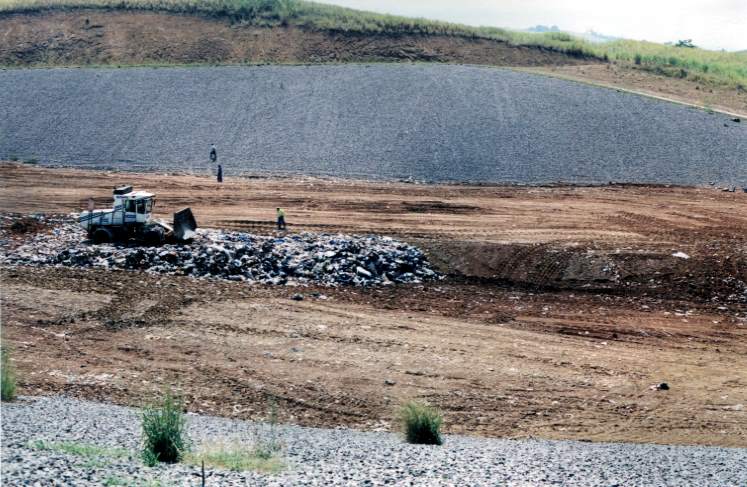
The third dimension of the challenge — and the one that most directly determines whether legacy landfill problems get dealt with competently and in a timely way — is the resource environment in which the responsible organisations are operating. And that environment has been, for well over a decade now, one of sustained and structural constraint.
Local authority contaminated land teams have been among the hardest-hit casualties of the budget reductions that followed the 2010 austerity period. In many authorities, specialist contaminated land posts that existed a decade ago have been deleted, left unfilled on vacancy, or merged into broader environmental health or planning roles whose occupants lack the specialist training and experience to carry out detailed legacy landfill assessment work.
The institutional knowledge that accumulated in the better-resourced contaminated land teams of the 2000s — knowledge about local site histories, about the geology and hydrogeology of specific areas, about the quirks and complexities of individual legacy sites — has in many cases walked out of the door with the officers who held it and has not been replaced.
The consequence is a capacity problem that manifests in very practical ways. A legacy landfill that comes to attention — through a planning consultation, through a monitoring result, through a resident complaint — requires a competent initial assessment to determine its significance and the appropriate response.
That assessment requires someone with the skills to:
- interpret the available information,
- identify the key uncertainties,
- commission appropriate specialist input where necessary, and
- make a defensible professional judgement about priority and next steps.
In authorities where those skills are no longer present in-house, the response is either delayed pending the commissioning of external consultants — itself a process that takes time and money — or is handled by staff who are doing their best with knowledge and experience that does not extend to the specific technical demands of legacy landfill assessment.
Site operators face a related but distinct version of the same problem. Waste management companies and landowners that have inherited responsibility for old closed landfill sites — through acquisition, through corporate restructuring, through the transfer of long-term aftercare obligations — are frequently managing sites whose history they know imperfectly and whose environmental condition they cannot fully characterise with the resources they have available.
The commercial imperative to manage aftercare costs efficiently can create pressure to do less investigation than the environmental risk would justify — a pressure that is entirely understandable in business terms, but that carries significant regulatory and reputational risk if a problem that should have been identified and addressed is subsequently discovered by a regulator or a third-party monitoring programme.
The financial constraint also affects the quality of the technical work that does get commissioned. CSM development for a legacy landfill with incomplete records, done properly, requires a meaningful investment in:
- forensic historical research,
- geological and hydrogeological characterisation, and
- the integration and interpretation of monitoring data.
Procurement processes that prioritise the lowest fee over the quality and thoroughness of the methodology tend to produce CSMs that are structurally adequate — they contain the right sections and the right headings — but that lack the depth and rigour to support the risk assessment and management decisions that depend on them.
A thin CSM is, in some respects, worse than no CSM at all, because it creates a false sense of assurance about the quality of the site’s conceptual understanding.
Why the Conceptual Site Model Is the Beginning of a Competent Response, Not an Optional Addition to One
Against this backdrop, it might be tempting to view the Conceptual Site Model as a technical document that belongs to a more resource-rich era — a standard that was appropriate when local authority contaminated land budgets were healthier and consultant day rates were easier to justify, but that cannot realistically be prioritised in the current environment. This view is not only mistaken. It is precisely backwards.
The CSM is not a luxury that can be deferred until resources are more comfortable. It is the tool that makes resource-constrained legacy landfill management possible at all — because it is the only framework for making rational decisions about where to spend the limited money that is available.
A site investigation designed without a robust CSM is almost certainly going to waste a significant proportion of its budget on boreholes in the wrong place, sampling for the wrong parameters, or investigating horizons that are not hydrogeologically relevant.
A risk assessment conducted without a properly structured CSM is going to miss linkages that matter and potentially focus attention on linkages that don’t.
A remediation programme implemented without a coherent conceptual model of how the site’s contamination behaves is going to achieve less than it spends.
In each case, the absence of a good CSM makes the work more expensive, not less — and makes the outcome less reliable, not more.
For legacy sites with missing records, the CSM also provides something that is genuinely valuable in a resource-constrained environment: a structured way of working productively with uncertainty rather than being paralysed by it.
A well-constructed CSM for a legacy site explicitly documents what is known, what is inferred from contextual evidence, and what is genuinely unknown — and it uses that uncertainty register to identify the specific investigations that would most cost-effectively reduce the uncertainties that matter most for risk assessment.
This is a fundamentally more efficient approach than either attempting a comprehensive investigation without a guiding conceptual framework, or deferring investigation entirely because the records are incomplete. It focuses limited resources where they will have the greatest impact on improving the quality of the site’s environmental risk assessment.
Working With What You Have: Developing CSMs for Sites Whose History Is Incomplete
One of the most persistent misconceptions among the professionals who manage legacy landfill sites is that a meaningful CSM requires a complete and reliable historical record to be developed. It does not — and this misconception, where it takes hold, has the practical effect of preventing CSM development entirely at the sites where it is most urgently needed.
The methodology for developing a CSM for a legacy site with incomplete records begins with a systematic programme of forensic historical research that goes considerably further than the standard desk study.
Historical Ordnance Survey maps, examined at regular intervals from the mid-nineteenth century onward, can reveal the progressive transformation of natural topographic features — former quarries, gravel workings, clay pits, low-lying ground adjacent to watercourses — that are characteristic of old disposal sites.
Wartime and post-war aerial photography, much of it accessible through the National Collection of Aerial Photography and other national archives, can show tipping operations in progress and define the site’s extent and surface topography at specific points in its operational history.
Planning application files, even for old sites, frequently contain descriptions of proposed operations that illuminate intended waste types and site management approaches.
Local authority archive records, county council minute books, trade press archives from the relevant period, and the records of the industries that were operating in the area during the years of tipping can all contribute valuable contextual information about the likely composition of the waste that was deposited.
This kind of research takes time and requires persistence and a degree of specialist knowledge about where to look and what to look for. But it consistently yields more useful information than practitioners who have not attempted it expect — and it regularly uncovers records and evidence that a standard desk study would completely miss.
The preliminary CSM that results from a thorough forensic historical research programme, even where it is acknowledged to be incomplete and inferential in significant respects, is a genuinely useful tool:
- it focuses the subsequent investigation on the areas and questions where the conceptual uncertainty is greatest, and
- it provides a structured baseline against which investigation findings can be evaluated.
The discipline that makes this approach work — and that distinguishes a genuinely useful CSM for a legacy site from a superficially adequate one — is intellectual honesty about the limits of the available evidence.
A CSM that documents its uncertainties explicitly, and that uses those documented uncertainties to drive a targeted and proportionate investigation programme, is a far more valuable professional and regulatory tool than one that presents a confident picture of a site’s contamination behaviour that is not actually supported by the evidence base from which it was drawn.
The Cost of Not Acting: Why Deferral Is Never the Neutral Option
For organisations managing legacy landfill challenges against a backdrop of constrained resources and competing priorities, the temptation to defer — to put a site in the too-difficult-for-now category and return to it when circumstances improve — is entirely understandable. It is also, in almost every case, a false economy.
Contamination from legacy landfill sites does not pause while the responsible organisation’s budget position improves. Leachate continues to migrate through the groundwater system. Gas continues to generate in waste masses that have not yet stabilised. The plume of contamination in a downgradient aquifer continues to advance toward receptors that may not yet be affected.
The longer action is deferred, the larger the contamination footprint becomes, and the more complex and expensive the eventual investigation and remediation programme will need to be.
The deferred decision that saves money in the short term consistently creates larger costs in the medium and long term — costs that fall not only on the environment and the communities affected by it, but on the organisations that are ultimately held responsible for the sites.
There is also a regulatory dimension to the cost of deferral that is easy to underestimate. An authority or operator that can demonstrate it has a current, proportionate, systematically maintained CSM for a legacy site — even where that CSM acknowledges significant uncertainties and identifies outstanding investigation needs — is in a fundamentally stronger regulatory position than one that cannot.
The CSM demonstrates that the organisation understands its site, is managing it in a structured and evidence-based way, and is progressing the investigation of identified uncertainties as resources permit.
The absence of a CSM, or the presence of one that is clearly out of date and inadequate, signals something very different — and in the event of a regulatory investigation or enforcement action, that difference matters considerably.
Frequently Asked Questions
What exactly is a legacy landfill and how widespread is the problem in the UK?
A legacy landfill is a closed waste disposal site that was operated before the modern sanitary landfill engineering standards and regulatory requirements that came into force from the 1990s onward. These sites were typically filled without engineered liners, leachate collection systems, gas extraction infrastructure, or systematic monitoring requirements.
The UK has a substantial stock of such sites — filled under the regulatory regimes of the 1950s, 1960s, 1970s, and early 1980s — and a consistent trickle of them surfaces each year as suspected or confirmed sources of pollution problems that require professional assessment and management.
Why do old closed landfills cause water pollution problems so long after they stopped receiving waste?
Landfill leachate — the contaminated liquid generated as rainfall percolates through decomposing waste — continues to be produced for decades, or in some cases centuries, after a site has closed.
Without a liner and leachate collection system, this leachate migrates freely into the surrounding geology and groundwater, moving slowly but continuously along hydraulic gradients toward surface water features and water abstractions.
The contamination process is inherently long-term, and the groundwater pathways involved mean that impact on a receptor may not become detectable until years or decades after leachate migration began.
How serious is the records problem for legacy landfill sites, and can anything be done about it?
The historical records deficit is a significant and genuine barrier, but it is rarely as complete as it appears at first examination. While formal waste acceptance records are frequently absent or imprecise for sites that predate systematic regulatory requirements, a systematic programme of forensic historical research:
- drawing on historical maps, aerial photography archives, planning records, local authority minutes, trade press archives, and contextual information about local industries
- can typically recover considerably more useful information than a standard desk study would reveal.
The key is committing the time and specialist effort to look in the right places, and being explicit within the CSM about what is inferred versus what is directly evidenced.
What is the Conceptual Site Model, and why does it matter for legacy landfill management?
The Conceptual Site Model is a systematic, evidence-based representation of a site’s contamination sources, the pathways by which contaminants can migrate, and the receptors that could be harmed — structured around the Source–Pathway–Receptor framework.
For a legacy landfill, it is the foundational document that gives structure and direction to everything else: site investigation design, environmental risk assessment, regulatory determinations under Part IIA of the Environmental Protection Act 1990, and remediation planning. Without a CSM, these activities lack a coherent analytical framework and are almost inevitably less effective and more expensive than they should be.
Why are local authority contaminated land teams struggling to keep up with legacy landfill problems?
Local authority contaminated land teams have faced sustained reductions in staffing and budget over the past fifteen years.
Specialist posts have been lost, institutional expertise has not been replaced as experienced officers have retired or moved on, and discretionary budgets for contaminated land investigation and assessment have been reduced to very low levels in many authorities.
The result is a significant gap between the rate at which legacy landfill concerns surface and the organisational capacity to respond to them with the thoroughness and timeliness that competent environmental management requires.
Can a Conceptual Site Model be developed for a site where most of the historical records are missing?
Yes, and it should be. A preliminary CSM that explicitly acknowledges its uncertainties and uses them to design a targeted investigation programme is far more valuable than either:
- waiting for a complete data picture that may never materialise, or
- proceeding with investigation and risk assessment without any structured conceptual framework at all.
Forensic historical research using non-standard sources — historical mapping, aerial photography, planning archives, contextual industry records — consistently recovers more useful information than practitioners expect, and provides a workable foundation for CSM development even where formal site records are sparse or absent.
What are the regulatory risks for an organisation that does not have an adequate CSM for a legacy landfill it is responsible for?
The regulatory risks are substantial. Under Part IIA of the Environmental Protection Act 1990, local authorities have a statutory duty to inspect their areas for contaminated land and to take appropriate action where sites meet the statutory definition.
An authority or operator that cannot demonstrate a systematic, evidence-based approach to assessing a suspected legacy landfill — an approach that a current CSM provides — is in a weak position in any regulatory or enforcement context.
Beyond the formal regulatory position, the absence of an adequate CSM also significantly increases the risk that investigation and remediation resources will be spent ineffectively, that pollution impacts will be identified later than they should be, and that the eventual cost of addressing the problem will be substantially higher than it would have been with earlier, structured intervention.
Is there a cost-effective approach to CSM development for organisations with very limited budgets?
Yes. The most cost-effective approach is a phased one:
- invest first in a thorough desk-based CSM drawing on all available historical and contextual sources,
- use that preliminary CSM to identify the specific uncertainties that matter most for risk assessment, and then
- commission targeted field investigation designed specifically to address those uncertainties.
This is considerably more efficient than either a comprehensive field investigation programme conducted without a guiding CSM, or a minimal desk study that produces a superficially adequate but technically thin document.
The upfront investment in a well-researched preliminary CSM consistently reduces total investigation and assessment costs by focusing resources where they will have the greatest impact.



You must be logged in to post a comment.