

US integrated containment strategies elevate landfill engineering through multi-barrier reliability — combining primary geomembrane liners, secondary backup systems, leak detection layers, and gas management infrastructure into a single, engineered system that maintains environmental protection over a design life of 100 years or more.
According to BPM Geomembrane market data, the global geomembrane market exceeded USD 3.2 billion in 2026, growing at a 5–6% CAGR, fueled by stricter EPA Subtitle D regulations, municipal solid waste increases, and hazardous waste containment requirements. HDPE dominates 65–75% of landfill liner applications due to its proven 50–100+ year design life and resistance to the full pH and chemical spectrum present in modern MSW leachate.
The Importance of Redundancy in Lining Design
The need for redundancy is underscored by field data. Research published in ScienceDirect’s geomembrane degradation study found that HDPE geomembranes used as the primary containment begin to age in their second year of landfill operation and can reach functional half-life by their eighth year under aggressive leachate conditions.
After the period, leachate leakage can increase from an initial level of 0.05–0.6 m³/day to a long-term range of 27.4–37.6 m³/day, with groundwater contamination probability shifting from ‘almost impossible’ to ‘almost certain.’
Properly engineered secondary containment with a functioning leak detection layer is the only safeguard against this failure mode.
Secondary containment prevents groundwater pollution from primary liner failures. High-level integration of primary geomembrane, leak detection layer, secondary geomembrane, and leachate collection drainage ensures 99.99% containment efficiency over the design life.
As Springer Nature’s leachate control reference states, the primary goal is to minimise the volume of leachate that percolates through the primary liner and to virtually prevent any migration through the secondary liner to natural formations below.
Engineering Design Principles
Primary Containment
- Basal double-liner systems: Primary HDPE liner over leak detection drainage geocomposite over secondary HDPE liner — captures 100% of any primary liner breach volume before groundwater contact
- Sidewall barriers: Anchored geomembranes extend containment up embankment slopes with hydraulic head control; textured HDPE increases interface friction by 25–50% on slopes, reducing shear failure risk per BPM Geomembrane data
- Fusion welding: Achieves parent-sheet seam strength — critical for seismic zones, differential settlement, and liner systems with high hydraulic head. Extrusion welding at 500–700°F yields seam peel/shear strengths at 90–100% of parent material strength
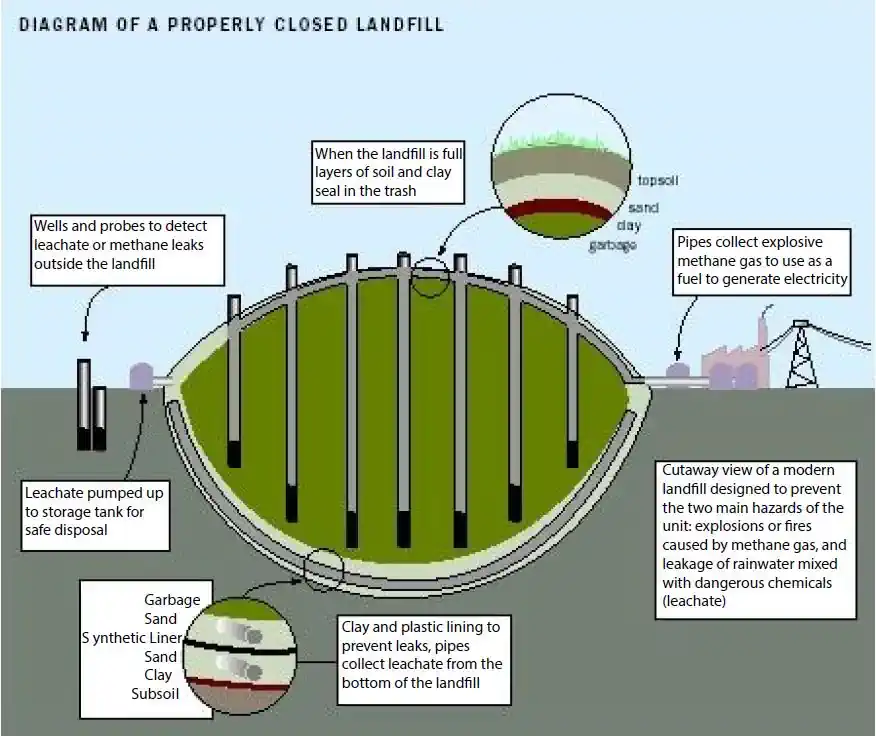
“Municipal Solid Waste Landfills | US EPA” from www.epa.gov and used with no modifications.
Secondary Containment Liner Technologies
Advanced HDPE excels in chemical resistance and UV stability for secondary containment. Per BPM Geomembrane’s 2026 market data, HDPE geomembranes dominate 65–75% of landfill liner applications with a permeability coefficient of ≤ 1 × 10⁻¹¹ cm/s — meeting or exceeding EPA Subtitle D/C and EU Landfill Directive requirements.
The most critical performance advantage of HDPE over alternative materials is its resistance to stress cracking, chemical absorption, and biological attack across the full pH range of MSW leachate (pH 2–13).
Fusion and Fabrication
- Hot-wedge dual-track welding: Creates pressurizable air channel between two weld tracks for 100% non-destructive seam testing without destructive sampling — the industry standard for primary liner seams in MSW and hazardous waste applications
- Extrusion welding: For patches, T-seams, and penetration boots — achieves seam strength of 1,500+ psi with proper technique and preheat at 500–700°F
- Large panel fabrication: Factory-welded panels up to 5 acres reduce field joints by 70%, dramatically cutting the number of field seams — the most common defect location in any liner system
- Plastic Fusion secondary containment: Multi-layer systems from specialists like Plastic Fusion Fabricators, Inc. deliver fusion-welded HDPE with full seam testing for MSW compliance.
System Integration
Per Springer Nature’s leachate control reference, the secondary containment system must manage leachate head through drainage geocomposites placed between the primary and secondary liners — keeping hydraulic pressure on the primary liner low enough to minimise transport through any defects. Monitoring pipes, sample leak detection layer flows for early detection at ppb concentration levels before groundwater impact occurs.
Field-Tested Expertise Over 40 Years
North American projects since 1984 highlight double-liner HDPE/GCL setups with leak detection geonets, ensuring 99.99% containment efficiency through precision welding and 100-year lifecycle engineering. Professional Applications
- MSW landfills: Double-liner systems per EPA Subtitle D with geonet leak detection layer
- Industrial landfills: Hazardous waste cells with composite liners per EPA Subtitle C
- Mining tailings ponds: Multi-liner systems adapted from landfill containment design
- Secondary spill containment: HDPE-lined berm systems for above-ground tank farms, loading areas, and industrial chemical storage
- Leachate ponds: Double-lined containment for leachate storage with leak detection and overflow management.
High-Level Recommendations (US)
- Specify ASTM D6392 seam testing: Required standard for geomembrane seam peel and shear strength testing — ensures seams meet parent material strength before accepting any liner installation
- Modular deployment: Factory fabrication of large panels accelerates field installation by 25%, reduces field seam count, and improves quality control compared to all-field welding
- Engineer for redundancy: Per ScienceDirect geomembrane degradation research, HDPE geomembrane ageing under field conditions can cause leachate leakage to increase by orders of magnitude within 10 years — secondary containment is not optional on any MSW or hazardous waste site
- 100-year lifecycle modelling: Probabilistic lifecycle analysis predicts 0.1% failure risk over 100 years for properly engineered double-liner systems with functional LDS monitoring per EPA MSWLF guidance
Frequently Asked Questions
What is the difference between primary and secondary containment in a US designed landfill?
Per Springer Nature’s landfill leachate control reference, the primary liner is the first barrier against leachate migration; the secondary liner is the backup that catches any leakage through the primary. Between them, a geonet or geocomposite leak detection layer collects and routes any leachate that breaches the primary liner to monitoring pipes for early detection.
What seam strength does EPA require for landfill liner systems?
EPA Subtitle D requires that liner system seams meet minimum strength standards per ASTM D6392. Hot-wedge and extrusion welded HDPE seams at 90–100% of parent material strength satisfy these requirements. All seams on Plastic Fusion’s liner installations are tested per project specifications and documented in as-built QA records.
How long does an HDPE secondary containment liner last?
Properly installed HDPE geomembrane liner systems have a design life of 50–100+ years in buried conditions. Per BPM Geomembrane’s 2026 review, carbon black content of 2–3% and stress crack resistance >1,000 hours are minimum specifications for landfill secondary containment liners at this service life target.
What is a leak detection layer and why is it required?
A leak detection layer is a permeable drainage geocomposite or geonet installed between the primary and secondary liners. It collects any leachate that breaches the primary liner and routes it to monitoring pipes. Per EPA MSWLF requirements, MSW landfills must monitor leak detection layer flows and report data under the Greenhouse Gas Reporting Program if methane generation exceeds 25,000 MTCO₂e annually.



You must be logged in to post a comment.